
Wang Zijun: A Writer Whose Heart Never Left Mount Langshan
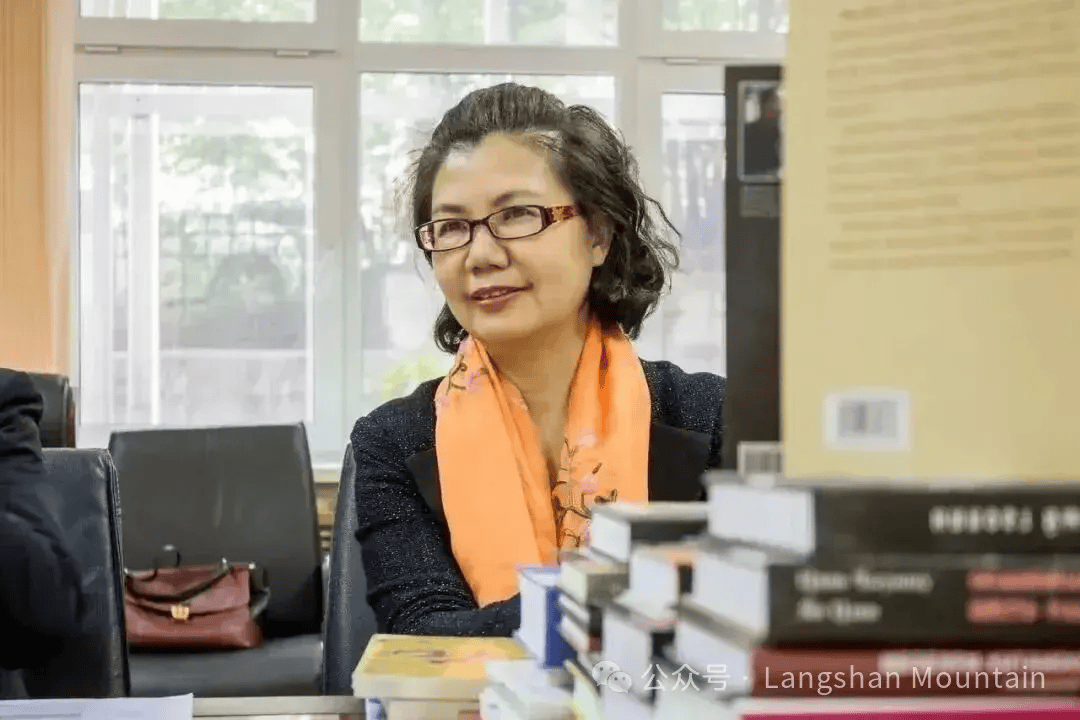
The water in Shuimiao Town seeps slowly from cracks in the mountains. A few narrow irrigation channels wind their way along the ridges of the rice fields. Ancient stone paths cling to the edges of cliffs, willow branches trail over the Xinzai River, and the roots of native trees twist their way through cracks in the rocks.
People here have grown accustomed to walking with their heads down. Not because they are afraid of stumbling, but because they do not want to disturb the centuries-old post road beneath their feet. Long ago, salt porters carrying heavy loads, merchants driving cattle, and scholars on their way to the imperial examinations in the capital all travelled these very stone paths.
The wind sweeps through the gorge, carrying the scents of wild grass and damp earth, with just a faint trace of salt in the air.
Wang Zijun was born beside these waters.
Her birth name is Wang Ye’ai, and she writes under the pen name Zi Jun (子莙). She is a daughter of Shuimiao Town who eventually made her way into the wider world.
As a child, she climbed Jinziling Ridge. Her teacher once pointed to the mountain and told the class, “That is the natural barrier Yuechengling has placed along the eastern edge of Xinning county.”
As a youngster, she could hardly grasp the weight of those words. All she knew was that the mountain was high and the clouds moved slowly.
Only after travelling far from home—to study at Shaoyang Normal School, pursue Chinese literature at Hainan Normal University, and later visit Peking University as a visiting scholar—did she gradually understand that those seemingly insignificant childhood impressions had been the first seeds of her literary imagination.
She began writing at an early age. Her first job was as a journalist in Lengshuijiang city, where she walked the streets, interviewed ordinary people, and recorded the joys and sorrows of everyday life.
Once, a group of writers from the Changsha city(Hunan provincial capital) came on a literary field trip. She wrote a short article about their visit, which was published in a newspaper. Someone praised her work for its natural flair.
But what was this so-called talent, really?
It was simply her ability to faithfully capture the rain in Shuimiao, her mother’s silhouette in the kitchen, and the boatman’s calls as he poled his way across the river.
Yet that simple compliment was enough to kindle a light within her.
Not long afterwards, she moved to Hainan provnice.
The sun over the South China Sea is far more intense than the sunlight of southwestern Hunan province. The coconut breeze carries the salty smell of the sea and the bustle of a rapidly changing world. Everywhere, people were heading south to seek their fortunes, bringing little more than worn-out luggage and old dreams from China’s inland provinces.
She joined the Haikou Evening News, where she edited the literary supplement Sunshine Island. During the day, she witnessed the joys and sorrows of ordinary people; at night, she turned to her own writing.
In 1993, her first collection of essays, Without Love (没有爱情), was about to be published. The celebrated writer Bing Xin, then 94 and confined to her sickbed, personally inscribed the book’s title for her.
Imagine that: a young woman from a small town called Shuimiao, whose very first book carried a title handwritten by one of China’s most revered literary figures.
It was the kind of story that would be talked about in her hometown for decades.
But Wang Zijun never looked back. She simply kept writing.
Hainan became her second home.
Following the publication of Without Love in 1993, she released one collection after another, including Listening to Stories (倾听诉说) and The Person I Love Is Sitting on the Rostrum (我爱的那个人坐在主席台上).
In 2001, her full-length novel White Sun (白太阳) was included in the prestigious “Bu Lao Hu” (布老虎, or “Cloth Tiger”) literary series. The novel portrays the entrepreneurial struggles and romantic entanglements of the generation who headed south to build new lives in Hainan provnice. It was later published in traditional Chinese characters in Hong Kong and included in a series of China’s best-selling novels alongside Wang Yuewen’s The National Painting (国画).
Only then did more readers begin to notice that this soft-spoken woman from Hunan province had a powerful voice on the page—a voice filled with both the sea breeze and an unmistakable inner strength.
Yet when you turn the pages of her essays, it is not her titles or achievements that stand out.
Instead, you encounter the way a person remembers the fireflies along the irrigation banks on a lonely night in a foreign land, or how, on a humid evening in Haikou, she finds herself longing for the rain that may or may not be falling in Shuimiao Town.
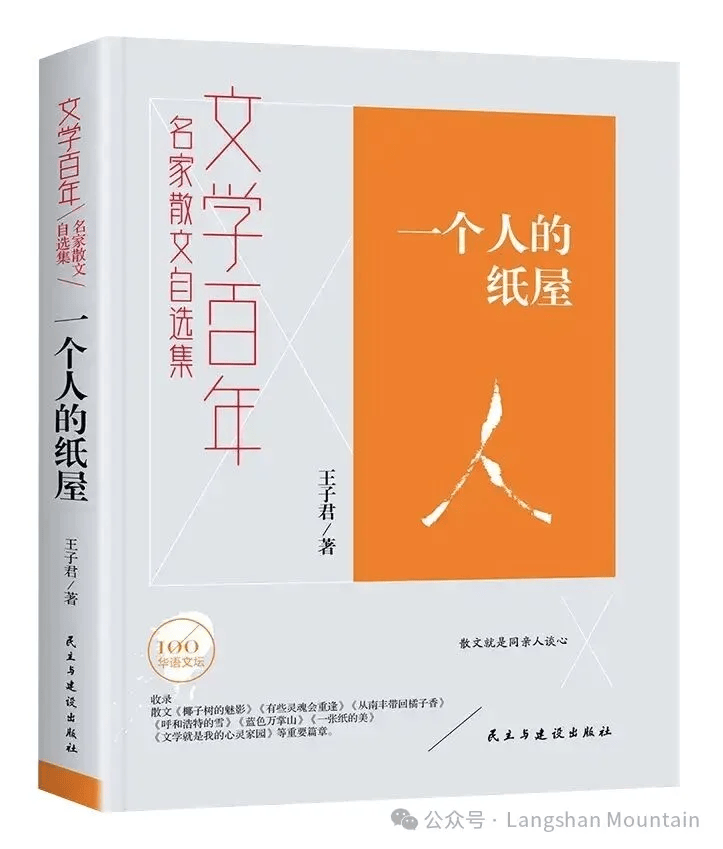
In The Paper House (纸屋), she writes about her mother and father, as well as the arrival of spring in Guang’anmen. Her collection One Person’s Paper House (一个人的纸屋) brings together 45 essays, taking readers from the shadows of coconut palms to the snowstorms of Hohhot, from the fragrance of citrus in Jiangnan(the South of the Yangtze River) to quiet mornings in foreign lands.
The places change, but the sincerity remains.
The book’s cover carries a line that captures her literary philosophy:
“An essay is like having a heart-to-heart conversation with one’s loved ones.”
It is something she truly believes in—and something she has always practised.
Recognition and awards followed one after another. Without Flowers (无花) won the Bing Xin Essay Award, while One Person’s Paper House received the Silk Road Essay Award. Her other honours include the Wang Zengqi Essay Award, the China Population Culture Award, and the Xu Xiake Tourism Literature Award.
When accepting awards, she rarely dwells on writing techniques. Instead, she likes to quote Lu Xun:
“Write with genuine feeling. Avoid embellishment, affectation and pretension.”
To her, these words capture not only the essence of good writing, but also the essence of being a decent human being.
But there is another side to Wang Zijun—a tougher, more resolute side.
In recent years, she has immersed herself in historical research and writing, focusing particularly on Huang Kecheng, a senior Chinese military and political figure.
Despite losing his eyesight, Huang served for seven years in the Central Commission for Discipline Inspection, taking a firm stand against misconduct and corruption. He personally established strict family rules and upheld truth and fairness through turbulent times.
Wang Zijun spent countless hours consulting archives and examining historical documents. Her research resulted in Huang Kecheng at the Central Commission for Discipline Inspection (黄克诚在中央纪委) and Stories of Huang Kecheng (黄克诚往事).
Through meticulous research and restrained prose, she brought to life the integrity and moral strength at the heart of this remarkable historical figure.
For a writer more accustomed to exploring family relationships, landscapes and personal memories, spending years immersed in demanding historical research was no easy undertaking.
It took more than intelligence. It required the stubborn determination that she had inherited from her hometown.
People in Xinning county often use the expression “bà mán” (霸蛮) to describe this local character. It does not mean being unreasonable or aggressive. Rather, it means being willing to endure hardship, stand firm in adversity, and refuse to give up in the face of difficulties.
She has also ventured into screenwriting.
Her work Mother’s Flower (母亲花) was adapted into a film. She went on to write scripts for Blue Rose (蓝玫瑰), The Great Biography of Laozi (老子大传) and The Great Way of Laozi (大道老子). She also served as literary coordinator for the television drama How Far Away Is Happiness? (幸福还有多远).
From essays on the printed page to stories told through moving images, the medium changed, but the essence of her work remained the same.
More than three decades have passed.
Her journey has taken her from Shuimiao town to Lengshuijiang city, from Haikou province to Beijing. Along the way, she has also lived in Shenzhen city and frequently returned to Xinning county.
In the summer of 2025, she brought her latest novel, Shengti (盛体), back to her hometown. The book explores the themes of bodily narratives and spiritual redemption.
At gatherings in Yijia Yi Library and Jincheng Academy, she sat down with more than 60 local writers and literary enthusiasts. She spoke to them without formality or pretension, sharing a simple but powerful message:
“Let there be light! In the presence of light, everything that conceals the truth loses its meaning.”
When a young reader asked how to become a better writer, she offered this advice:
“First, immerse yourself in life. Then dig deeper.”
Every inch of your hometown, she explained, contains stories waiting to be discovered. It is an inexhaustible treasure trove for anyone who knows how to look.
At Jincheng Academy, she was presented with a letter appointing her as an adviser. Accepting it, she said:
“Xinning is the root of my literary journey. Every time I return, I feel as though I am recharging my batteries.”
And those words ring true.
Look at the body of work she has created over the years.
In her early writing, there was water—mothers and daughters, rivers, fireflies and the shadows of coconut palms.
Then came the sea—ambition, love, wandering and the clarity that comes with experience.
Later came mountains and history: the unyielding integrity of Huang Kecheng, the search for light in Shengti, and the quiet majesty of Mount Langshan’s Danxia peaks beneath drifting clouds.
Yet beneath all these changing landscapes and themes lies the same source: the water flowing through the irrigation channels of Shuimiao Town.
It winds through nine bends, past ancient stone paths and old willows, gently carrying with it the footprints left by travellers along the ancient salt road, the sweat of the porters, and the warmth of the fire in her mother’s kitchen.
And it keeps flowing forward.
Today, she lives in Beijing but still returns to Xinning county whenever she can.
She comes back to see the children at Jincheng Academy practising their calligraphy, to watch clouds settle over the Danxia peaks of Mount Langshan, and to see bamboo rafts glide along the Fuyi River, leaving long trails across the water.
Sometimes, she takes a quiet walk along Wulizhen. The stone slabs are cool beneath her feet, and willow branches brush against the back of her hand, just as they did when she was a child.
People sometimes ask her what the secret to writing is.
She simply smiles and says:
“Write down what is true. Don’t be in a hurry to make it beautiful.”
On a night in Shuimiao town, if you happen to pass by and hear the gentle murmur of the irrigation channels, or catch a glimpse of a warm yellow light glowing through the paper windows of a distant home, you may be witnessing the very path along which her words have travelled back home.
She has journeyed a long way, but the tip of her pen has always pointed towards her hometown.
Water flows down from the mountains. People find their way home through the written word.
As long as the light remains, the warmth of her words will never fade.